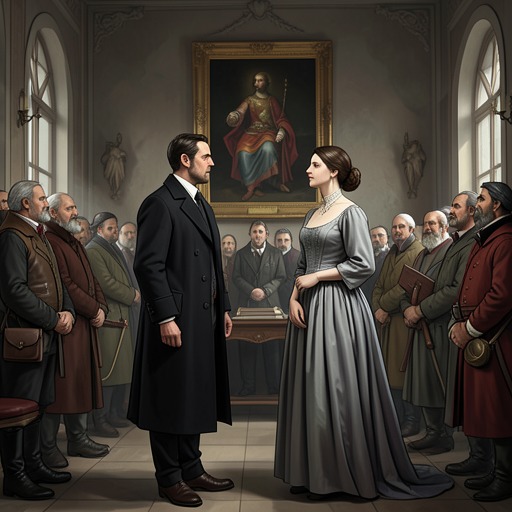
Mary Boleyn
Wolf HallMary Boleyn is presented as Henry VIII’s married mistress and Anne Boleyn’s elder sister, a figure whose private relationship with the king becomes a matter of court intelligence. Thomas Cromwell reports the affair to Thomas Wolsey, who weighs not only its implications for Katherine of Aragon but also the advantage the Boleyn family might seek from it. Mary herself remains outside the scenes: her significance lies in what others infer from the king’s attention and in the political possibilities that attention creates.
Identity and Introduction
When Cromwell brings Wolsey court gossip, he explains that orders to silk merchants have led women to suspect the king has taken a new lover. The woman is not Anne, then associated with Henry Percy, but her sister Mary. Wolsey recognizes her as a kind-hearted blonde who had returned from the French court, where she was said to have moved among its men, with Anne following close behind. This description establishes Mary through reputation and family contrast rather than through her own speech or actions.
The King’s Affair and Court Intelligence
Wolsey asks whether Henry and Mary are close, whether Katherine knows, and what presents Mary has received. Cromwell indicates that the gifts are not lavish. Wolsey considers the affair a temporary opportunity for Mary to secure an advantage, but does not expect her to cause great difficulty. The exchange presents royal intimacy as information to be assessed: Cromwell’s role is to carry gossip to Wolsey, who turns it into a judgment about the king’s household and the uses others might make of his attention.
Wolsey also recalls a story that, before he became king, Henry had been involved with Elizabeth Boleyn, Mary and Anne’s mother. The story is treated as hearsay, not established fact; Cromwell says he never believed it. Wolsey’s speculation that the king may lack imagination connects the alleged earlier liaison with his present interest in Mary, but leaves the supposed pattern uncertain.
Marriage, Family, and Succession
Mary is already married, a fact Wolsey regards as politically useful. If she bears a child, her husband may choose whether to acknowledge it, leaving the child’s status uncertain. Wolsey contrasts this possibility with Henry’s acknowledged son by John Blount’s daughter: Henry Fitzroy, created Duke of Somerset and Duke of Richmond while still under ten. The king’s existing son makes the consequences of any further royal child more than a private matter, since an enlarged royal family could generate competing claims and conflict among mothers seeking standing for their children.
The Boleyn family’s possible gain is likewise framed as political rather than romantic. Asked what the family had received from Henry’s earlier interest, Cromwell answers that it had the chance to make itself useful. Wolsey makes a note about what Thomas Boleyn might obtain if he asked. Mary’s affair thus appears within a court system where royal favor can be converted into service, access, and advancement, even though the text does not specify a particular reward for Mary or her relatives.
Narrative Role
Mary’s presence is mediated by the men discussing her: she is identified by kinship, reputation, marriage, and the king’s attention, while her own intentions remain unstated. That distance makes her a point of uncertainty in Wolsey and Cromwell’s calculations. Her relationship with Henry might benefit her family, unsettle Katherine, or produce a child whose recognition would matter; none of those possibilities is presented as a settled outcome. The account therefore treats Mary less as a participant in the narrated court scenes than as a consequential figure whose private life is read for its political effects.